20th May - 1st June 2024

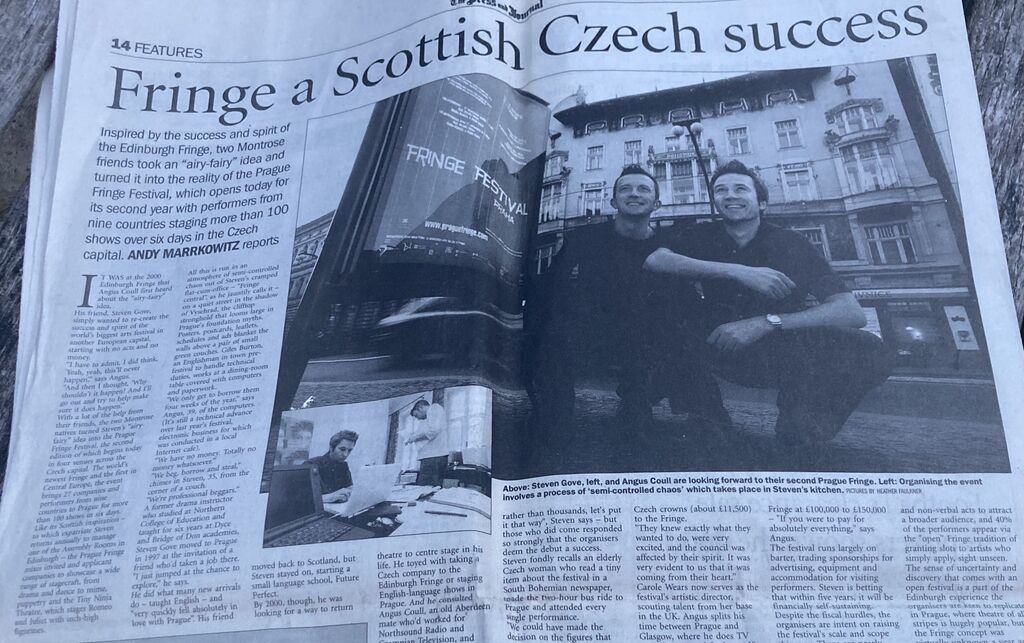
Fringe: A Scottish-Czech Success (from the achive 3.6.2003)

Inspired by the success and spirit of the Edinburgh Fringe, two Montrose friends took an “airy-fairy” idea...


... and turned it into the reality of the Prague Fringe Festival, which opens today for its second year with performers from nine countries staging more than 100 shows over six days in the Czech capital.

Andy Marrkowitz reports - Press and Journal (Aberdeen) June 3 2023


It was at the 2000 Edinburgh Fringe that Angus Coull first heard about the “airy-fairy” idea. His friend, Steven Gove, simply wanted to re-create the success and spirit of the world’s biggest arts festival in another European capital, starting with no acts and no money.

“I have to admit, I did think, ‘Yeah, yeah, this’ll never happen,’” says Angus. “And then I thought, 'Why shouldn’t it happen?' And I’ll go out and try to help make sure it does happen.”


With a lot of help from their friends, the two Montrose natives turned Steven’s 'airy-fairy' idea into the Prague Fringe Festival, the second edition of which begins today in four venues across the Czech capital.

The world’s newest Fringe and the first in Central Europe, the event brings 27 companies and performers from nine countries to Prague for more than 100 shows in six days.


Like its Scottish inspiration — to which expatriate Steven returns annually to manage one of the Assembly Rooms in Edinburgh — the Prague Fringe mixes invited and applicant companies to showcase a wide range of stagecraft, from drama and dance to mime, puppetry and the Tiny Ninja Theatre, which stages Romeo and Juliet with inch-high figurines.

All this is run in an atmosphere of semi-controlled chaos out of Steven’s cramped flat-cum-office - 'Fringe central', as he jauntily calls it - on a quiet street in the shadow of Vyšehrad, the cliff-top stronghold that looms large in Prague’s foundation myths. Posters, postcards, leaflets, schedules and ads blanket the walls above a pair of small green couches.

Giles Burton, an Englishman in town pre-festival to handle technical duties, works at a dining-room table covered with computers and paperwork.

'We only get to borrow them four weeks of the year,' says Angus, 39, of the computers. (It’s still a technical advance over last year’s festival, electronic business for which was conducted in a local Internet café.)

'We have no money. Totally no money whatsoever.'

'We beg, borrow and steal,' chimes in Steven, 35, from the corner of a couch.

'We’re professional beggars.'

A former drama instructor who studied at Northern College of Education and taught for six years at Dyce and Bridge of Don academies, Steven Gove moved to Prague in 1997 at the invitation of a friend who’d taken a job there.

'I just jumped at the chance to explore,' he says.

He did what many new arrivals do - taught English - and 'very quickly fell absolutely in love with Prague'. His friend left Prague but Steven stayed on starting a small language school - Future Perfect.

By 2000 though he was looking for a way to return to the centre stage of his life. He toyed with taking a Czech company to the Edinburgh Fringe or staging English-language shows in Prague.  He consulted Angus Coull, an old Aberdeen mate who’d worked for Northsound Radio and Grampian Television.

'We all came to a point where we thought, 'Why stop there?' Steven says. 'And I thought, 'Let’s start a Fringe Festival in Prague.''

'From the moment the idea started, it was never going to have a chance to go away. It was always there. I was always thinking about it, always wondering how I could get things going.'

The first festival was mounted with little money, little publicity and little more in the way of a goal than getting through the week. Attendance was sparse.

'It was hundreds rather than thousands, let’s put it that way,' Steven says.

But those who did come responded so strongly that the organisers deemed the debut a success.

Steven fondly recalls an elderly Czech woman who read a tiny item about the festival in a South Bohemian newspaper, made the two-hour bus ride to Prague and attended every single performance.

'We could have made the decision on the figures that we’re never going to do this again, because it would have been financially ruinous, but it wasn’t about that, Angus says. 'We decided to carry on because of the reaction we got from more or less everyone that was there. There was a great atmosphere that was really the kind of atmosphere we wanted to create.'

Prague City Council also took to the festival early and remains its biggest funder.
'It was the enormous enthusiasm and the excitement from the organisers that persuaded the council to go for it,' says Zdena Zárská, an arts liaison for the council, which this year contributed 500,000 Czech crowns (about £11,500) to the Fringe.

'They knew exactly what they wanted to do, were very excited, and the council was affected by their spirit. It was very evident to us that it was coming from their heart.'

Angus splits his time between Prague and Glasgow, where he does TV work 'to try and feed myself, basically'.

Steven cheerfully admits that he and Angus are 'completely in the red', working more or less full time without salary on festival fundraising, booking and logistics. They estimate the full cost of mounting the Fringe at £100,000 to £150,000. 'If you were to pay for absolutely everything,' says Angus.

The festival runs largely on barter, trading sponsorships for advertising, equipment and accommodation for visiting performers. Steven is betting that within five years it will be financially self-sustaining.

Despite the fiscal hurdles, the organisers are intent on raising the festival’s scale and scope this year. There are nearly twice as many shows and low ticket prices — 35 to 200 crowns (about 80p to £4.60) — to encourage attendees to experiment.
In contrast to last year’s all-invited, all-English-speaking line-up, there are several Czech and non-verbal acts to attract a broader audience, and 40 per cent of the performers appear via the 'open' Fringe tradition of granting slots to artists who simply apply, sight unseen.

The sense of uncertainty and discovery that comes with an open festival is part of the Edinburgh experience the organisers are keen to replicate in Prague, where theatre of all stripes is hugely popular but the Fringe concept was virtually unknown a year ago.

'It should be the sort of thing where people are willing to take a risk to see something,' Steven says.

'You want to take in as much as you can in a short time. So I think a big part of the aim this year is to make it more like a Fringe than it was last year.'

He has seen only about one-third of this year’s scheduled acts, but he’s not concerned.
'They’ll all be interesting,' he says.

Back